
Project 10
AI Tools for Microrobotic Additive Manufacturing Process Optimization
(prof. Dan Popa, ECE Dept./LARRI)
Flexible Hybrid Electronics (FHE) is a technology combining advantages of printed and traditional electronics to create devices that can adjust to their environment - bend, stretch, and twist. Manufacturing FHE devices usually involves printing methods, electronic component placement, and low-temperature bonding. To manufacture FHE’s, our team designed the NeXus system, a robotic prototyping platform that enables the automation of basic procedures including precision positioning, printing, sintering, assembly, and packaging processes, leading to prototypes the size of a tablet or smaller (Figure 1). The NeXus has the flexibility to fixture, position, transport, and assemble components across a wide spectrum of length scales (1 micron to 0.1 m) and provides unique additive capabilities such as inkjet printing (IJP), aerosol jet printing (AJP), and FDM printing of microstructures, thermal processing using photonic sintering, in-situ microassembly, packaging and interconnect formation, as well as metrology [1-5]. Custom control solutions and user interfaces enable the realization of digital workflow and implementation of Machine Learning (ML)/Artificial Intelligence (AI) for the Nexus’s deposition processes [6].
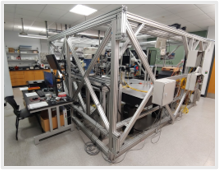
Robotic NeXus system at UofL
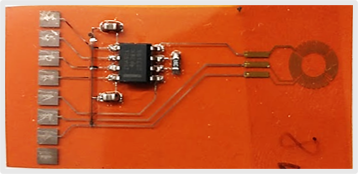
A flexible tactile sensor with sensor area and signal conditioning electronics
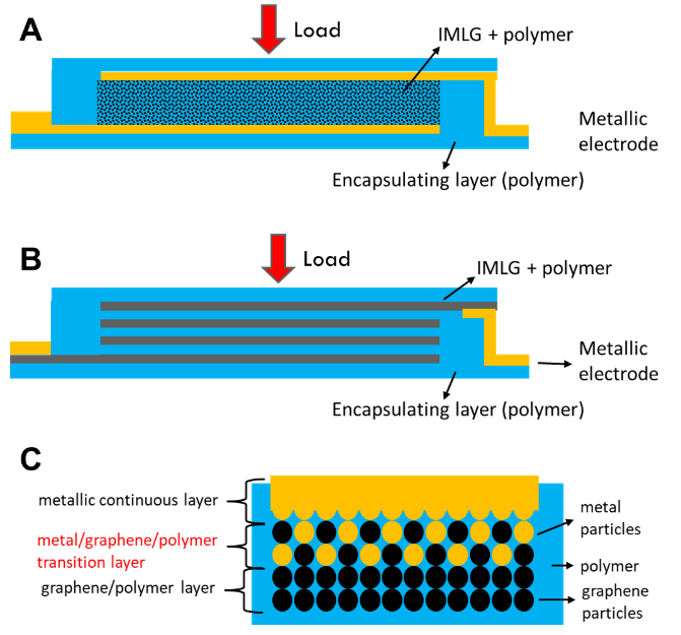
Concept of the tactile sensor on a flexible substrate manufactured using the NeXus system and based on incommensurate multi-layer graphene (IMLG). A: graphene-polymer mixture; B: capacitor graphene/polymer “sandwich” structure. C: proposed design of the metallic electrode - polymer/graphene interface.
The research project in this REU program will involve optimization of the material deposition process of conductive and insulating inks for prototyping of a tactile flexible hybrid electronic sensor. The conductive inks will include Ag nanoparticles and graphene, while the insulators will include silicones and other polymers, and these materials have to be fine-tuned for the subsequent IJP, AJP, and Photonic Sintering.
The optimization of the fabrication process of graphene-based sensors will be achieved by implementing an ML/AI framework within NeXus. This framework will be developed and validated based on an initial version of NeXus’ digital twin, thus enabling simulation of the manufacturing process of the sensor. ML/AI tools will help to optimize the AM processes and allow for rapid testing of sensor properties.
A two-phase optimization framework will be used to refine process parameters for sensor structure fabrication using the NeXus platform. Since direct hardware exploration on NeXus is costly, the first step of the process development will rely on virtual digital twins. Specifically, we use two physics guided hybrid digital twins for the most important fabrication steps: ink-jet deposition and post processing. Each model combines a simplified process-level physics description with experimental data already available from prior NeXus studies and new material specific measurements collected during the project. The data driven portion of the twins will be implemented using Gaussian process-based regression (GPR) [6], which are well suited to limited manufacturing datasets and require less training time. In the second stage of optimization, we will use reinforcement learning to optimize the deposition process parameters, including event driven soft actor critic (SAC) [7-9] and extremum seeking control (ESC) [10] to optimize process settings identified by digital twins.
References:
1. Sherehiy, Andriy; Popa, Dan O; Wei, Danming; Nimon, Andrew Scott; Alqatamin, Moath Hasan; Tofangchi, Alireza; Hsu, Keng; Walsh, Kevin; Harnett, Cindy; Druffel, Thad; Ratnayake, Dilan; Curry, Alexander; Challa, Sushmita; Ghahremani, Amir Hossein; Jackson, Doug; Zhang, Ruoshi; Blasiak, Antoine; Saadatzi, M Hossein; McGrady, Garrett; “Robotic systems for additive manufacturing”, US Patent App. 17/845,526, pending, 2023
2. Sherehiy, Andriy; Jackson, Douglas; Sassa, Michael; Sills, Daniel; Ratnayake, Dilan; Zhang, Ruoshi; Yang, Zhong; Walsh, Kevin; Naber, John; Popa, Dan O; “Aerosol Jet and Inkjet Printing Methods for Die-Level Packaging of Custom MEMS Devices”, Journal of Micro and Nano Science and Engineering, 13, 1, 2025
3. Sills, Daniel T; Sherehiy, Andriy; Zhang, Ruoshi; Jackson, Douglas; Reynolds, Henry; Ratnayake, Dilan; Caid, Cassidy; Popa, Dan O; “Rapid Prototyping of Multiscale Flexible Printed Circuit Boards with NeXus, a Robotic Additive Manufacturing System”, Journal of Micro and Nano Science and Engineering, 13, 1, 2025
4. Wei D, Zhang R, Lin J, Ratnayake D, Olowo OO, Nimon AS, Alqatamin M, Sherehiy A, Popa DO. Precision evaluation of tactile sensor fabrication using a robotic additive manufacturing platform. Journal of Micro and Bio Robotics,08; 20:1, 2024
5. Olowo O, Zhang R, Lin J, Wei D, Sherehiy A, Jackson D, Ratnayake D, Tofangchi A, Popa D. Design and Fabrication of an Aerosol Jet Printed Tactile Sensor on Flexible Substrate. IEEE Journal on Flexible Electronics. 2023; 2(2):190-200.
6. Zuniga-Navarrete C, Ratnayake D, Sherehiy A, Walsh KM, Popa DO, Segura L., “Conductivity Modeling of Intense Pulsed Light Sintered Printed Electronics via Gaussian Process-Enhanced RA-GAN”, Journal of Computing and Information Science in Engineering, 25, 1, 011005, 2026.
7. T. Haarnoja, A. Zhou, K. Hartikainen, G. Tucker, S. Ha, J. Tan, V. Kumar, H. Zhu, A. Gupta, P. Abbeel, and S. Levine, “Soft actor-critic algorithms and applications,” (2019).
8. T. Haarnoja, A. Zhou, P. Abbeel, and S. Levine, “Soft actor-critic: Off-policy maximum entropy deep reinforcement learning with a stochastic actor,” (2018).
9. R. S. Sutton, “Reinforcement learning: An introduction,” A Bradford Book (2018).
10. Krstić, Miroslav, and Hsin-Hsiung Wang. 2000. “Stability of Extremum Seeking Feedback for General Nonlinear Dynamic Systems.” Automatica 36 (4): 595–601.

